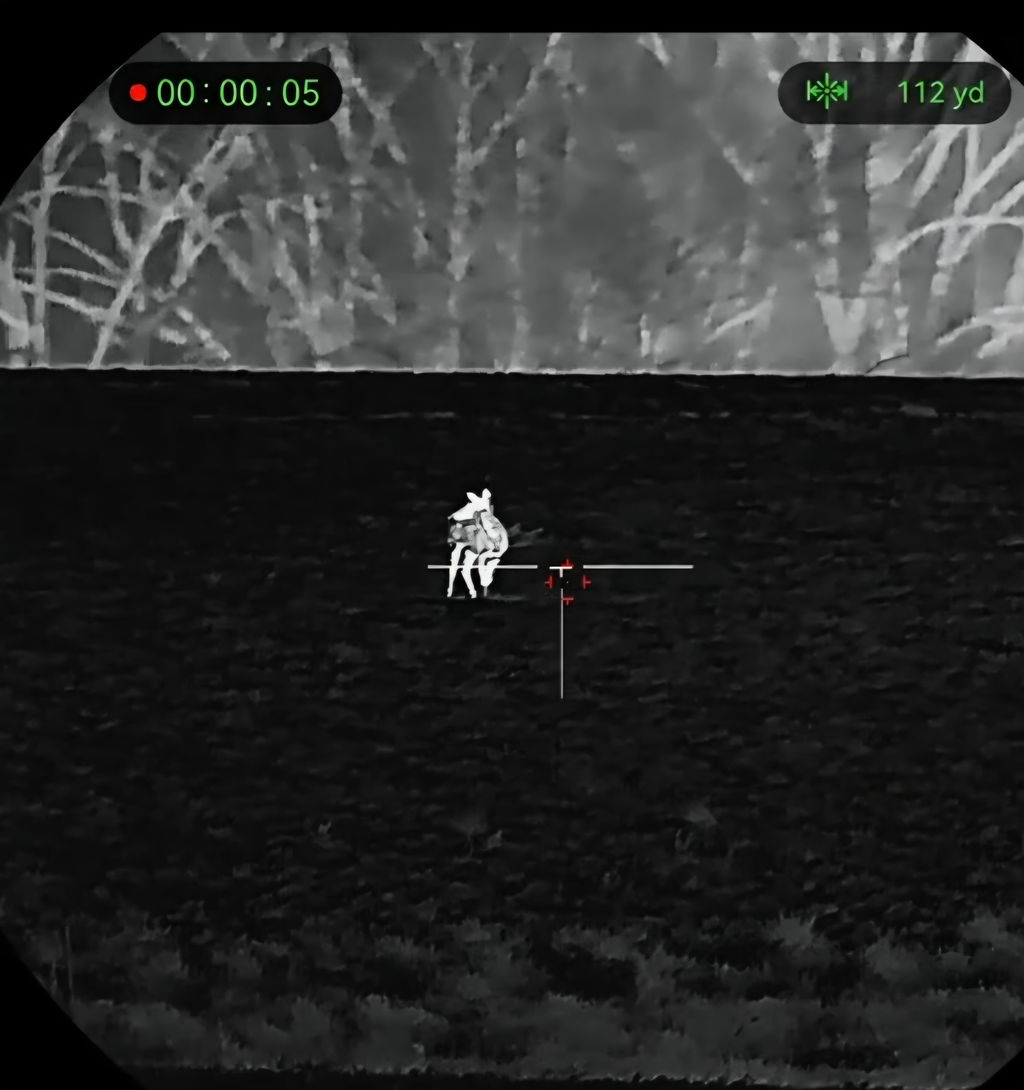
384 vs 640 vs 1280 Thermal: Which Resolution Do You Really Need?
Bruce NolanShare
If you're shopping for a thermal scope or thermal monocular, one of the first specifications you'll encounter is sensor resolution. Today, some of the most common choices are 384, 640, and 1280 thermal sensors.
It's easy to assume that the highest resolution is automatically the best choice. While a higher-resolution thermal sensor can provide substantially more image detail, resolution is only one part of what determines how a thermal optic performs.
Lens size, base magnification, field of view, pixel pitch, thermal sensitivity (NETD), display quality, image processing, and the distance at which you'll actually use the optic all matter.
So, do you really need a 1280 thermal? Is 640 worth the additional cost over 384? And is a good 384 still enough for most hunters?
Let's break it down.
What Does Thermal Resolution Mean?
A thermal sensor contains thousands of individual detector elements, or pixels, that measure infrared energy.
For example, common sensor resolutions include:
- 384 × 288
- 640 × 512
- 1280 × 1024
The higher the resolution, the more thermal information the sensor can capture to construct the image you see.
A 384 × 288 sensor contains about 111,000 pixels.
A 640 × 512 sensor contains about 328,000 pixels.
A 1280 × 1024 sensor contains more than 1.3 million pixels.
That means a 1280 × 1024 sensor has roughly four times as many pixels as a 640 × 512 sensor and nearly 12 times as many as a 384 × 288 sensor.
That's a huge difference on paper—but it doesn't mean a 1280 thermal will automatically be 12 times better than a 384.
384 Thermal: Still an Excellent Choice
Browse our 384 thermal optics, or see a current 384-class example such as the AGM Rattler V3 35-384 LRF thermal scope.
A quality 384 thermal remains one of the best values in thermal imaging.
Modern 384-resolution optics can provide excellent performance for hunting, predator control, property management, and general thermal observation without the price of higher-resolution systems.
Who Should Consider 384?
A 384 thermal makes a lot of sense if you're:
- Buying your first thermal optic
- Hunting at typical short-to-medium distances
- Trying to stay within a reasonable budget
- Looking for a secondary thermal scanner
- More concerned with practical performance than having the absolute best image available
For many hunters, 384 is all they actually need.
Where you'll begin to notice its limitations is when targets become smaller or farther away, or when you use substantial digital magnification. With fewer pixels available to represent the target, image detail deteriorates faster as digital zoom increases.
That's where 640 begins to show its advantage.
640 Thermal: The Sweet Spot for Many Buyers
Compare our 640 thermal optics, including premium options such as the Nocpix RICO 3 Pro H50R 640 thermal scope.
For years, 640 × 512 has been considered premium thermal resolution, and it's still an excellent choice.
Compared with 384, a 640 sensor captures significantly more thermal information. That can translate into better detail, easier target recognition, improved performance at longer distances, and more usable digital magnification.
For many serious hunters, 640 is the sweet spot between performance and price.
Why Choose 640?
A 640 thermal is worth considering if you:
- Hunt regularly
- Need better target detail at longer distances
- Frequently use digital zoom
- Want a wider field of view without sacrificing as much detail
- Want a noticeable step up from an entry-level thermal
- Plan to keep the optic for several years
One of the biggest advantages isn't necessarily seeing an animal that a 384 couldn't detect.
Both may detect the heat source.
The difference is often how much information you have to determine what you're actually looking at.
Being able to detect a heat signature and being able to confidently identify it are two very different things.
1280 Thermal: The New High-End Standard
Explore our 1280 thermal optics, including the Nocpix RICO 2 S75R 1280 thermal scope.
Thermal technology has advanced rapidly, and 1280-resolution sensors represent another major step forward.
A 1280 × 1024 sensor contains more than 1.3 million thermal pixels. That's four times the pixel count of 640 × 512.
The additional resolution can produce exceptional detail, especially when viewing smaller targets, observing at longer distances, or using digital magnification.
It can also allow manufacturers to design optics with combinations of wide field of view and high image detail that would have been difficult to achieve with lower-resolution sensors.
Who Should Consider 1280?
A 1280 thermal may make sense if you:
- Want some of the best thermal image quality currently available
- Frequently hunt or observe at longer distances
- Want maximum target detail
- Use digital magnification frequently
- Want a wide field of view while retaining substantial image detail
- Are upgrading from an existing 640 thermal
- Want premium technology and aren't primarily shopping based on price
The biggest question isn't whether 1280 is better.
It is whether the improvement is worth the additional cost for the way you actually use your thermal.
For some buyers, absolutely.
For others, a good 640 will provide everything they need.
384 vs 640 vs 1280 at a Glance
| Resolution | Approx. Pixels | Best For | Main Advantage |
|---|---|---|---|
| 384 × 288 | 111,000 | Value-conscious buyers, beginners, typical hunting distances | Excellent performance for the money |
| 640 × 512 | 328,000 | Serious hunters and more demanding users | Great balance of detail, range and price |
| 1280 × 1024 | 1.31 million | Premium buyers and demanding long-range applications | Maximum detail and better digital-zoom potential |
Don't Choose a Thermal Based on Resolution Alone
This is extremely important.
Two thermal optics with the same sensor resolution can produce noticeably different images.
Resolution tells you how many detector pixels the thermal sensor contains. It doesn't tell you everything about the complete imaging system.
Other specifications to consider include:
NETD / Thermal Sensitivity
NETD indicates how well the thermal sensor can distinguish very small temperature differences.
Generally, a lower NETD value indicates greater thermal sensitivity.
This can become especially important when environmental conditions reduce thermal contrast.
Pixel Pitch
You'll commonly see specifications such as 12µm or 17µm.
Pixel pitch affects the relationship between sensor size, lens, magnification, field of view, and overall optical design.
It shouldn't be evaluated by itself.
Objective Lens
A 35mm, 50mm, or 60mm lens can dramatically change how an optic behaves.
Larger isn't automatically better.
Your ideal lens depends heavily on your desired base magnification, field of view, and typical engagement distance.
Base Magnification
A high base magnification can be useful for longer-distance shooting, but it comes at the expense of field of view.
Someone hunting large open fields may prefer a very different thermal than someone hunting wooded terrain at 75 yards.
Field of View
Field of view is particularly important when scanning or tracking moving animals.
A wider FOV makes it easier to locate and follow targets, while a narrower field of view is often associated with greater optical magnification.
Image Processing
Modern thermal optics rely heavily on software and image processing.
Two devices using sensors with similar specifications can still produce noticeably different images because of how each manufacturer processes the sensor data.
This is one reason specification sheets don't tell the entire story.
What Happens When You Use Digital Zoom?
This is one area where higher sensor resolution can provide a major advantage.
Digital zoom essentially enlarges a portion of the sensor image. As you increase digital magnification, you're working with fewer original pixels.
A higher-resolution sensor starts with more information.
Consequently, a 640 thermal generally retains more usable detail under digital magnification than a comparable 384, while a 1280 system has even more sensor information available.
If you regularly find yourself using 2× or 4× digital zoom, moving to a higher-resolution sensor can be especially worthwhile.
Does Higher Resolution Mean Longer Detection Range?
Not necessarily.
Manufacturers frequently advertise very long detection ranges, but detection simply means the thermal can detect a heat source.
It does not necessarily mean you can identify exactly what that heat source is at that distance.
When comparing thermal optics, it's helpful to think about three different things:
Detection: You can tell something warm is there.
Recognition: You can begin determining what type of object or animal you're seeing.
Identification: You have enough information to confidently determine what the target is.
Higher resolution can be especially beneficial for recognition and identification, not simply detection.
Is 384 Good Enough for Coyote and Hog Hunting?
For many hunters, yes.
A quality 384 thermal can be extremely effective for both coyote and hog hunting.
If most of your shots are at typical hunting distances and you're trying to maximize value, there is nothing inherently inadequate about a 384 sensor.
However, hunters working larger fields, shooting at longer distances, or wanting greater target detail may benefit significantly from moving to 640.
For buyers seeking the highest level of detail available—and who are comfortable with the additional expense—1280 offers another substantial step up.
Should You Upgrade From 384 to 640?
If you already own a 384 and are happy with it, don't upgrade simply because 640 has a larger number on the specification sheet.
Upgrade because you're trying to solve a limitation you're actually experiencing.
Maybe you want:
- Better image detail
- More useful digital zoom
- Better target identification at distance
- A wider FOV without sacrificing as much detail
- Improved overall image quality
If those are things you regularly wish your current optic did better, 640 can be a meaningful upgrade.
Should You Upgrade From 640 to 1280?
This decision is more difficult.
A good 640 thermal is already extremely capable.
Moving to 1280 isn't about making an unusable optic usable. It's about moving from an already high-performance thermal system into the newest premium tier.
The difference will make the most sense to buyers who appreciate additional image detail, regularly use their equipment at longer distances, use digital magnification, or simply want the best thermal technology their budget allows.
If your current 640 already does everything you need, there's nothing wrong with keeping it.
So Which Thermal Resolution Should You Buy?
For most buyers, I'd look at it this way:
Choose 384 if you want the best balance of affordability and practical thermal performance.
Choose 640 if you're willing to spend more for noticeably greater detail and want an optic that can handle more demanding hunting situations.
Choose 1280 if image quality and detail are top priorities and you're willing to pay for the newest generation of premium thermal performance.
Most importantly, don't buy based on resolution alone.
A high-quality 384 can be a better choice for a particular application than the wrong 640, and the right 640 can make more sense than spending considerably more for a 1280.
The best thermal is the one whose sensor, lens, magnification, field of view, thermal sensitivity, features, and price all match how you're actually going to use it.
Shop Thermal Optics by Device Type
After choosing the resolution that fits your needs, compare our thermal scopes for dedicated and clip-on options or browse thermal binoculars for comfortable two-eye observation and multispectral features.
Need Help Choosing?
With so many thermal scopes, monoculars, binoculars, and different sensor resolutions available, comparing specification sheets can become overwhelming.
At Night Vision Universe, we carry thermal optics ranging from affordable entry-level models to today's premium high-resolution systems.
If you're trying to decide between 384, 640, or 1280, feel free to contact us. Tell us what you'll be using the optic for, your typical distances, and your budget, and we'll help narrow down the choices.
Our goal isn't to sell you the thermal with the biggest number on the specification sheet.
Also checkout our other blog - Beyond the Pixels
It's to help you find the thermal that's right for you.